Brief IDEAS No 17
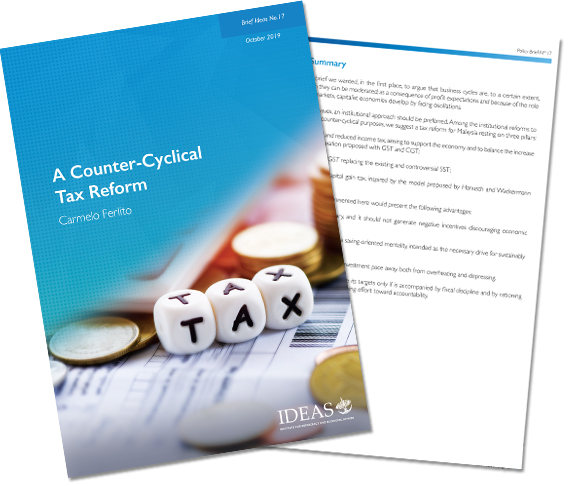
A Counter-Cyclical Tax Reform
Author: Carmelo Ferlito
In this brief Dr Carmelo identifies that business cycles are unavoidable and to address this, policy makers should establish a set of rules which help to prevent the economy from overheating and cushion the impact when the economy inevitably slows down. To achieve that, Dr Carmelo proposes three reforms to Malaysia’s tax system:
First, a reformed, more progressive GST to replace the existing and controversial SST. Crucially, reintroduction of GST must be done in a way that address the concerns that led to its abolition, including that the burden of the tax falls disproportionately on the middle class. To address this Dr Carmelo proposes the introduction of different GST rates for different purchases, including a higher “luxury” rate for purchases associated with higher income households;
Second, a progressive Capital Gains Tax (CGT) on profits made from the disposal of assets, including company shares. This tax is inspired by the model proposed by Hanusch and Wackermann (2011) and is intended to help manage the extremes of the business cycles. When the economy is overheating, CGT will help to reign in speculative investments and when the economy is stagnating, CGT will encourage investors to leave their money in the capital market to support more sustainable development;
Third, to ensure that the Malaysia’s economy remains competitive and the overall burden on the people is not increased, Dr Carmelo proposes a reformed and reduced income tax to balance the increase in indirect taxation proposed with a new goods and services tax (GST) and a new capital gain tax (CGT).
Dr Carmelo argues that the scheme presented in the paper would present the following advantages:
- it is not distortionary, and it should not generate negative incentives discouraging economic activity;
- it nudges in favour of a saving-oriented mentality, intended as the necessary drive for sustainably financed investments;
- it would help keep the investment pace away both from overheating and depressing.