
Policy Paper No 5
Private education for the poor?
Author: Joanna Lim and Wan Saiful Wan Jan
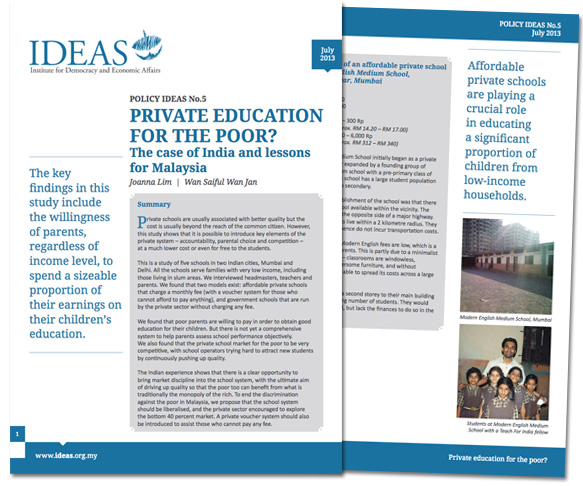
Private schools are usually associated with better quality but the cost is usually beyond the reach of the common citizen. However, this study shows that it is possible to introduce key elements of the private system – accountability, parental choice and competition – at a much lower cost or even for free to the students. This is a study of five schools in two Indian cities, Mumbai and Delhi. All the schools serve families with very low income, including those living in slum areas. We interviewed headmasters, teachers and parents. We found that two models exist: affordable private schools that charge a monthly fee (with a voucher system for those who cannot afford to pay anything), and government schools that are run by the private sector without charging any fee. We found that poor parents are willing to pay in order to obtain good education for their children. But there is not yet a comprehensive system to help parents assess school performance objectively. We also found that the private school market for the poor to be very competitive, with school operators trying hard to attract new students by continuously pushing up quality.
The Indian experience shows that there is a clear opportunity to bring market discipline into the school system, with the ultimate aim of driving up quality so that the poor too can benefit from what is traditionally the monopoly of the rich. To end the discrimination against the poor in Malaysia, we propose that the school system should be liberalised, and the private sector encouraged to explore the bottom 40 percent market. A private voucher system should also be introduced to assist those who cannot pay any fee.


